2-step allows transferable prediction of liquid chromatography retention times: predictions for new and known chromatographic setups (including new columns) across the space of biomolecules. A graph neural network-based architecture is used to first predict a Retention Order Index (ROI) based on compound structure and parameters of the chromatographic setup. The underlying model is trained on reversed-phase datasets from RepoRT. Using a set of anchor compounds – a few compounds for which the retention time is known on the target chromatographic setup – ROIs are mapped to the retention time domain. Anchor compounds can be authentic standards measured on the target setup, but also high-confidence library hits.
Installation
A python package is available from GitHub, with dependencies installable via conda/mamba. A Docker file and container are available as well. A local copy of RepoRT is required.
Usage
Predictions can be made with the predict script, with metadata provided in YAML format and anchors as well as structures for the compounds to predict provided in TSV format. See the README for detailed instructions, also on training and evaluation.
Web service
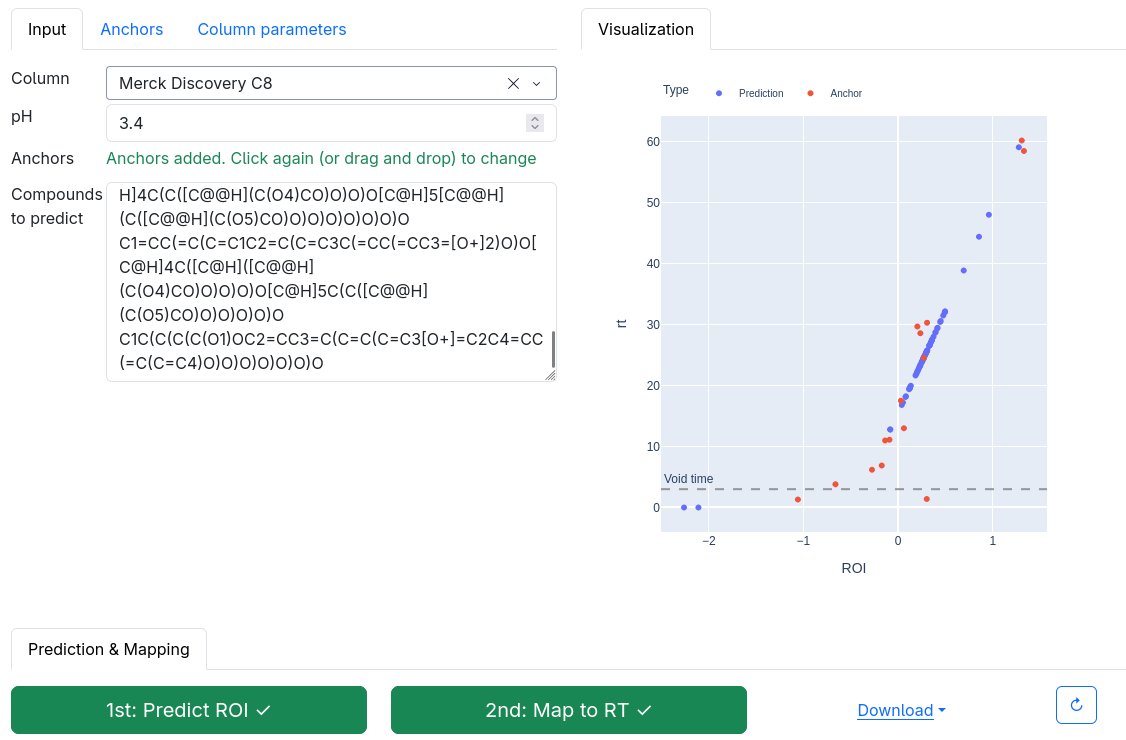
A web app for 2-step is available here. The LC column can either be directly selected, or HSM and Tanaka parameters can be entered manually in the “Column parameters” tab. If parameters are not available, similar columns may be used as proxies. Data for anchor compounds can be uploaded in TSV, CSV or Excel format. Compounds for which to make predictions have to be provided as SMILES, preferably PubChem-standardized (see also here). The threshold for the void volume (anchors with retention times below will be ignored) can be set in the “Anchors” tab. Prediction of ROIs is possible without anchors.
References
F. Kretschmer, E.-M. Harrieder, M. Witting, and S. Böcker
Times are changing but order matters: transferable prediction of small-molecule liquid chromatography retention times
Nat Methods, 2026.
https://doi.org/10.1038/s41592-026-03243-2
for RepoRT:
F. Kretschmer, E.-M. Harrieder, M. A. Hoffmann, S. Böcker, and M. Witting
RepoRT: a comprehensive repository for small molecule retention times
Nat Methods 21(2):153-155, 2024
https://doi.org/10.1038/s41592-023-02143-z