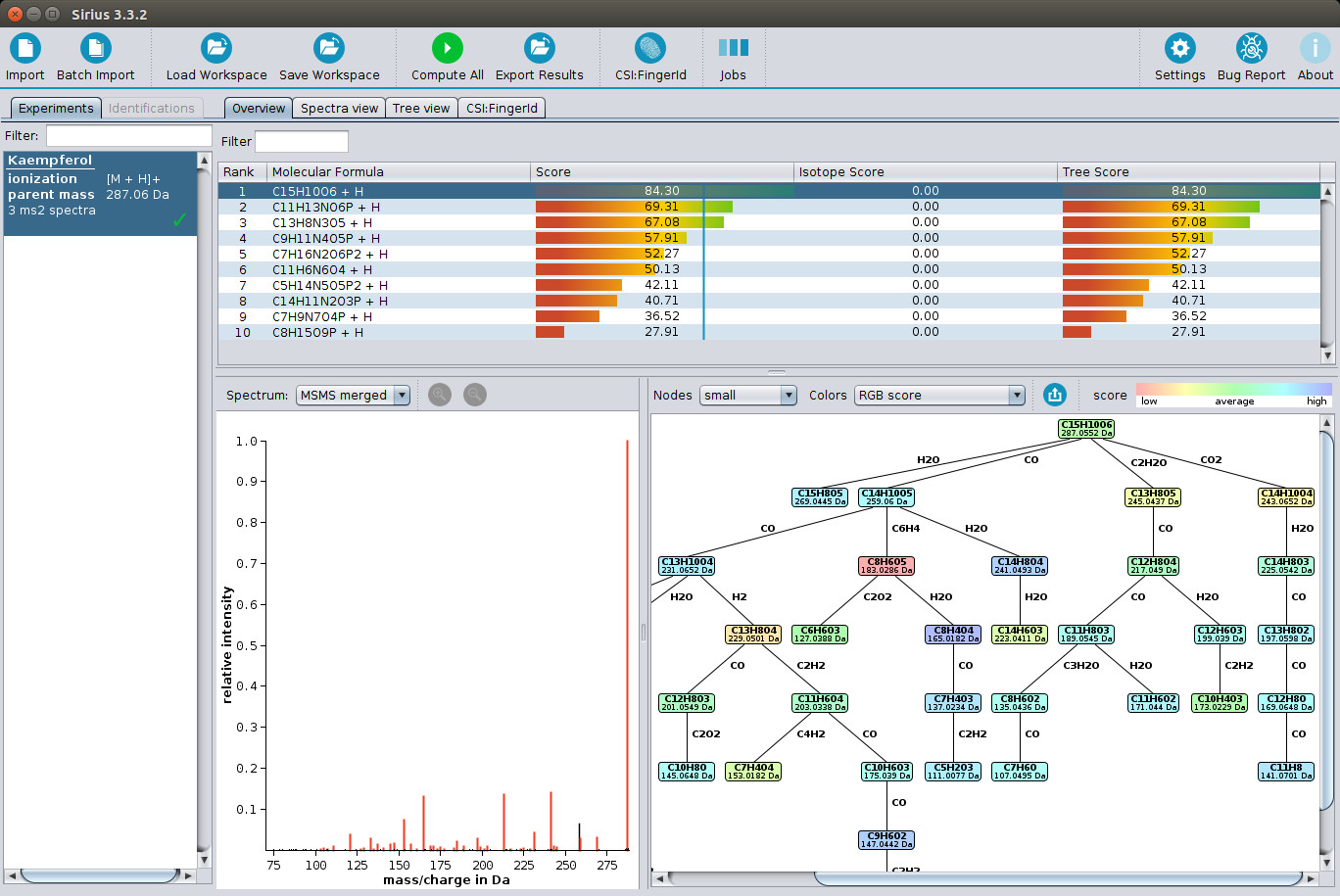
With the release of the new SIRIUS version (and, behind the scenes, a new version of CSI:FingerID), we want to share some numbers so you know if it was worth the hassle. We use CASMI 2016 data, to allow you to compare our results against those of other methods. We use the candidate structures provided as part of category 2, automated structural identification. See also Schymanski et al. (J Cheminf 2017).
For molecular formula identification, we use both isotope patterns and fragmentation patterns. (Isotope pattern data were released after the contest.) We consider all molecular formulas — we will not get bored to stress that if you limit molecular formulas to those found in some structure database, you will never ever find a new molecular formula. We find that SIRIUS 4 identifies the correct molecular formula for 91.3% of the challenges.
Next, we use CSI:FingerID to identify the compound structures. During the last year, the CASMI 2016 data have found their way into the CSI:FingerID training data. We know that CSI:FingerID has excellent identification performance if a spectrum for this structure is present in the training data (expect anything between 70% and 95%). But this is not challenging, and also does not tell us how good SIRIUS and CSI:FingerID can identify truly novel compounds.
To this end, we excluded all structures from CASMI 2016 from the training data. Hence, any structure is novel, in the sense that CSI:FingerID has never before seen any MS/MS data for this structure. SIRIUS 4 and the new CSI:FingerID reach 37.8% correct identifications for novel structures and positive ion mode; this is significantly better than the 27.6% reported in the CASMI paper (Schymanski et al., J Cheminf 2017). In addition, we can now also process challenges in negative ion mode, thanks to the training data available in NIST; here, we reach 28.4% correct identifications for novel structures.
These numbers are for “unambiguously correctly” identified structures: Sometimes, two candidate structures have exactly the same molecular fingerprint and are scored with exactly the same score. If we include these “ambiguously correctly” identified structures, numbers increase to 40.2% and 30.9%, respectively.
By the way: The idea of a challenge is to be challenging. That is why category 2 of CASMI 2016 uses candidate lists directly extracted from ChemSpider. In application, you will probably use a smaller candidate lists, which will make identification easier and improve identification rates: For example, unambiguous correct identifications for novel structures and positive ion mode increase to 71.7% if we search in a biomolecular structure database with “only” 0.5 million structures.
To cut a long story short: SIRIUS 4 and CSI:FingerID provide outstanding performance for molecular formula and structure identification. As mentioned in the release news, it is also much faster than before: On a set of 1533 GNPS compounds, we observed a 36-fold speedup.
Update: Two bugs had to be corrected in our evaluation. Minor: We chose the wrong parameter set (TOF vs. Orbitrap), resulting in small ID rate changes. Major: We did not search in the biomolecule DB but rather in “biomolecules plus MINEs”. Fixing this resulting in pretty dramatic changes.